Writing · AI / Automation / Tech
A research team printed a forearm crutch for $16.50 to $20.
Then they tried to break it. Four batches. Small printers and big ones. New plastic and recycled plastic. Every batch went through the standard load test, held about the same weight, and failed the same way at extreme loads. Forbes puts the store-bought version at around $200.
Elon Musk has a name for that gap. The idiot index: what a finished part costs, divided by what its raw materials cost. The crutch comes in around 10.
What does this have to do with CRE investments? Well, start with your HD Supply website.
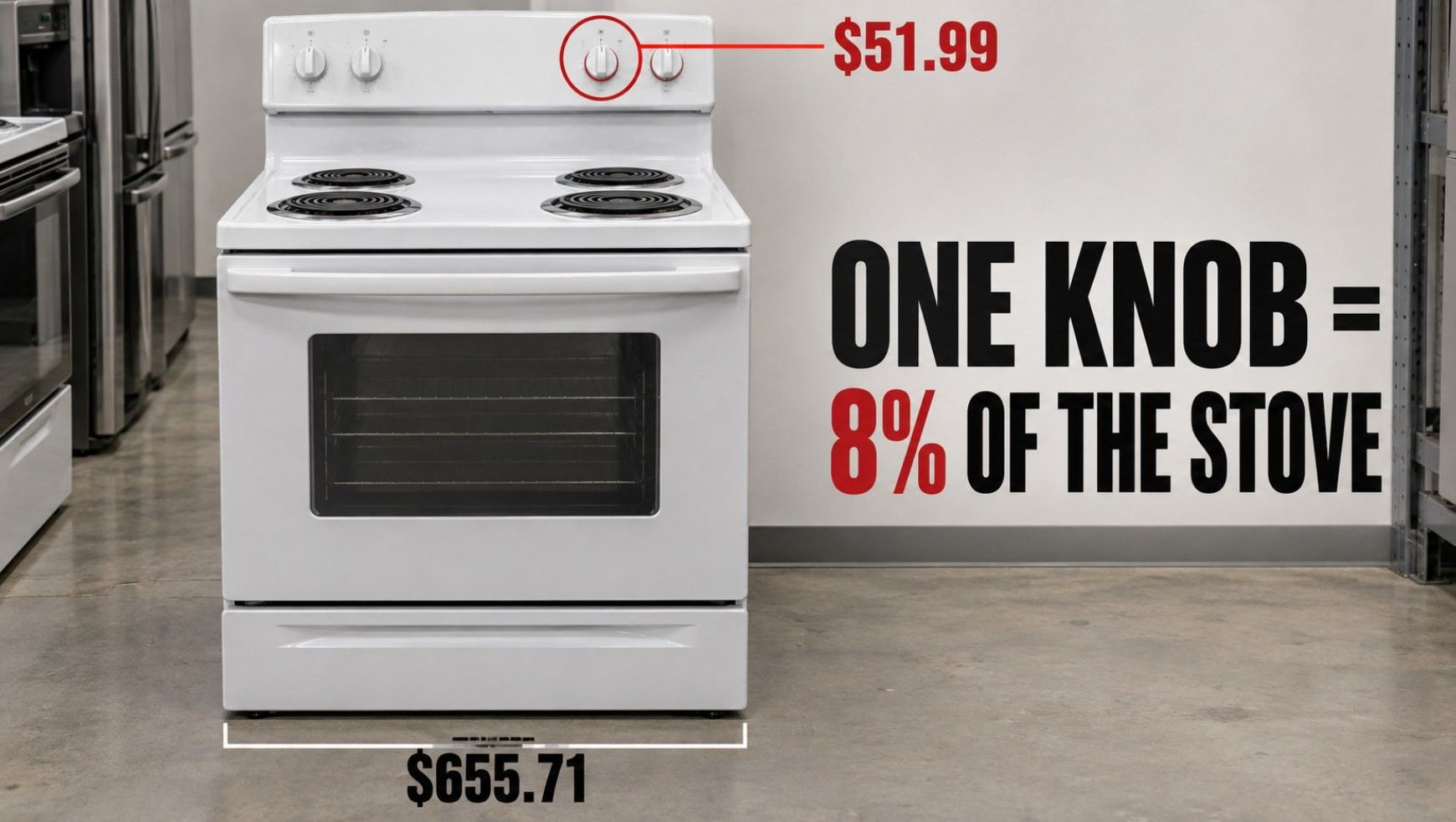
A Frigidaire range knob lists at $51.99. The same catalog sells its own house-brand 30-inch electric range for $655.71. One knob is 8% of a new stove!
Printer plastic runs about $20 a kilo, roughly 2.5 cents a gram once you count the prints that fail. Give that knob a generous 40 grams and the material costs a dollar.
Idiot index: 52.
Keep flipping. Whirlpool fridge door bin, $140.99. Crisper drawer cover frame, $130. Freezer drawer slide rail, $121.
If printed plastic can hold up a grown adult on one leg, I'd like to hear the case for a $52 knob.
Worse is the part that's been discontinued. Then the fix can be a whole new appliance.
Would a printed part hold up?
Mostly, if you're picky. Printed plastic is weaker than injection-molded plastic, and a printed part can be 4 to 5 times stronger along its layers than across them. That's why the crutch worked. It was designed for the printer, with the loads running the right way. A knob, a door bin, a blind bracket, a window pivot shoe, fine. A grab bar, no. The crutch had a lab test behind it. Your tech's grab bar won't.
What does it cost to start?
A Bambu Lab P2S, an enclosed printer that handles tougher plastics like PETG and ABS, runs $549. The slicer software is free. Commercial design software from Autodesk is about $680 a year, and plenty of common parts already have free files floating around.
Eleven knobs at list price pay for the printer.
Somebody still has to draw the part. A handy tech with calipers can learn it. Or pay a local print shop to model it once, then print it every time one breaks.
The real cost is tech time, a learning curve, and owning the part if it fails. Keep it out of water lines, gas, and anything a person leans on. Use heat-rated plastic like ABS near a burner.
Whirlpool started digitizing its parts catalog years ago to beat obsolescence. Deutsche Bahn has printed more than 6,000 train parts. I went looking for an apartment owner doing this and came up empty.
Solve a part once. Save the file. Every property prints the same part.
The printed knobs won't win a beauty contest yet. That's mostly the machine and the hand behind it. Cheap printers leave rough layers. New designers leave clumsy edges. Both are getting better every year.
I am keeping an eye on these 3D printers. The tech that changes this business tends to look like a toy right before it doesn't.