Writing · AI / Automation / Tech
Before: Chalk, Tape, Knees. After: 99% Less Physically Straining Work.
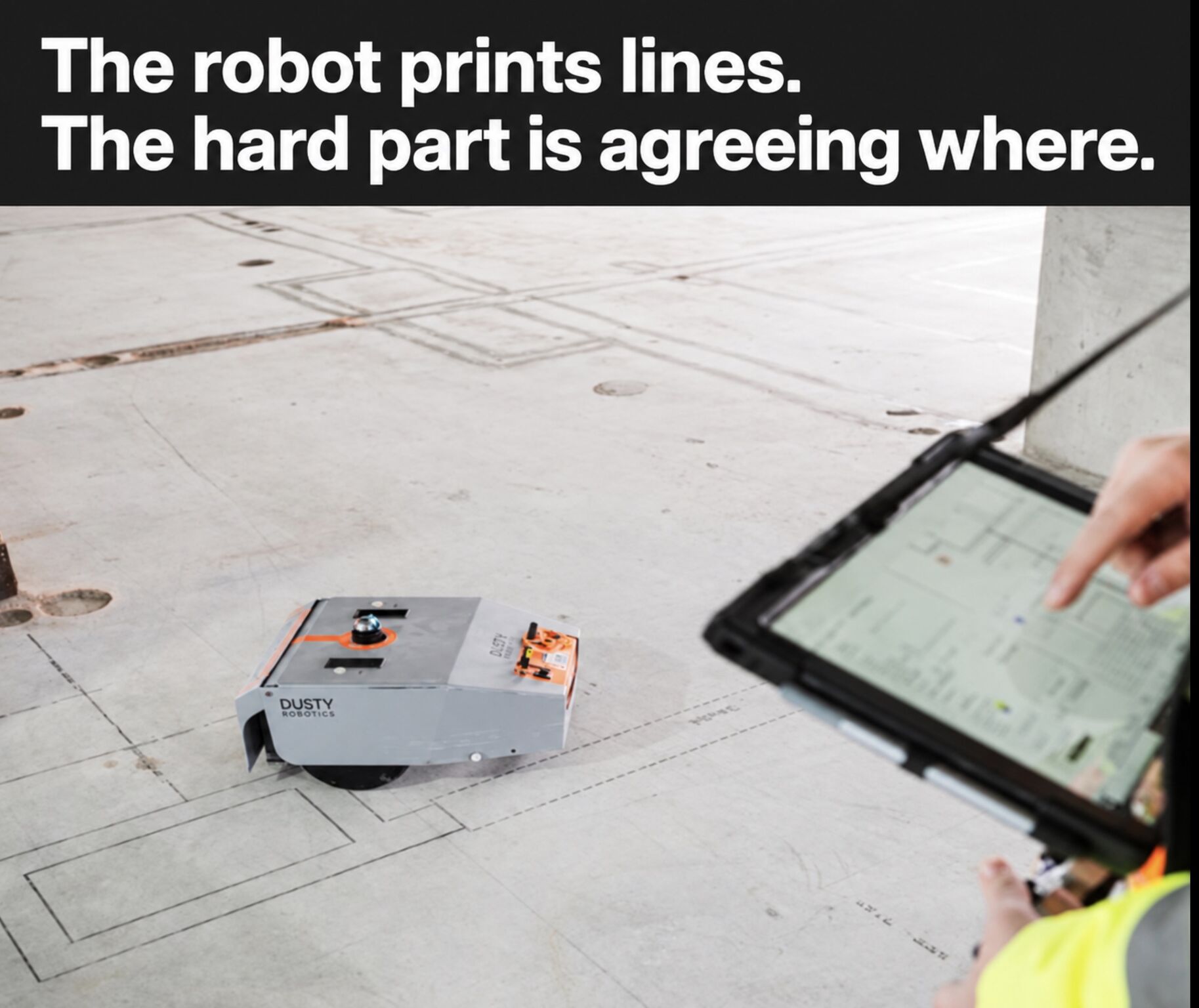
A robot printed floor layouts in Naples. The headline said AI. What it did was draw lines.
Dusty Robotics' FieldPrinter takes the coordinated building model and prints it on the concrete at 1/16 inch accuracy. Walls, duct runs, hanger points, labels. One person covers 10,000 to 15,000 square feet a day. Suffolk ran it at Moorings Park Grande Lake.
A peer-reviewed study on an 8-floor medical office building in LA put numbers on it. 68% fewer layout labor hours. 1,749 hours saved, about $131,000. Break-even penciled around $1,900 a day.
Run it for drywall alone and you still get 56% of that savings. Run four trades off one model and you get all 68%.
The machine pays on a single trade. Coordination nearly doubles the take.
Coordinating early is easy to promise in a meeting. Print day is a date on a calendar, and the ink stops if the files aren't ready. The robot's second job is being a deadline you can't argue with.
Which raises a bigger question. What would a construction company look like if someone built it the way Musk built a rocket company?
His sequence starts with questioning the requirement, then deleting the step, then simplifying, then speeding up. Automation comes fifth. Skip the first four and you automate a process that shouldn't exist.
Start with the change order, and be honest about what's in that pile. Some are the owner changing his mind. Some are allowances, which are decisions nobody made yet. Some are escalation, tariffs, an inspector reading code his own way. Software doesn't touch any of that.
What it touches is the coordination miss. The duct that lands in the beam. The scope that fell between two drawing sets. Errors that surface a year later, after the steel is up, at a multiple of what the same fix cost in design. Train a model on enough completed jobs and the collision gets flagged while it's still an email.
Value engineering changes meaning too. Today it mostly means cheaper finishes. Trained on real as-builts it could mean the same building with less steel and the same look.
The rocket comparison is worth considering. Shuttle-era launch ran about $54,000 a kilogram. Falcon 9 runs about $2,700. Starlink exists because of that gap and for no other reason. Cheap access didn't improve the satellite business. It created a different one.
Take 50% out of vertical construction and the same thing happens here. Hard cost stops being the binding constraint. Dirt and entitlement become the main part of underwriting.
Replacement cost is the floor under what your existing buildings are worth. Cut it in half and the floor moves.