Writing · Pricing / Revenue Management
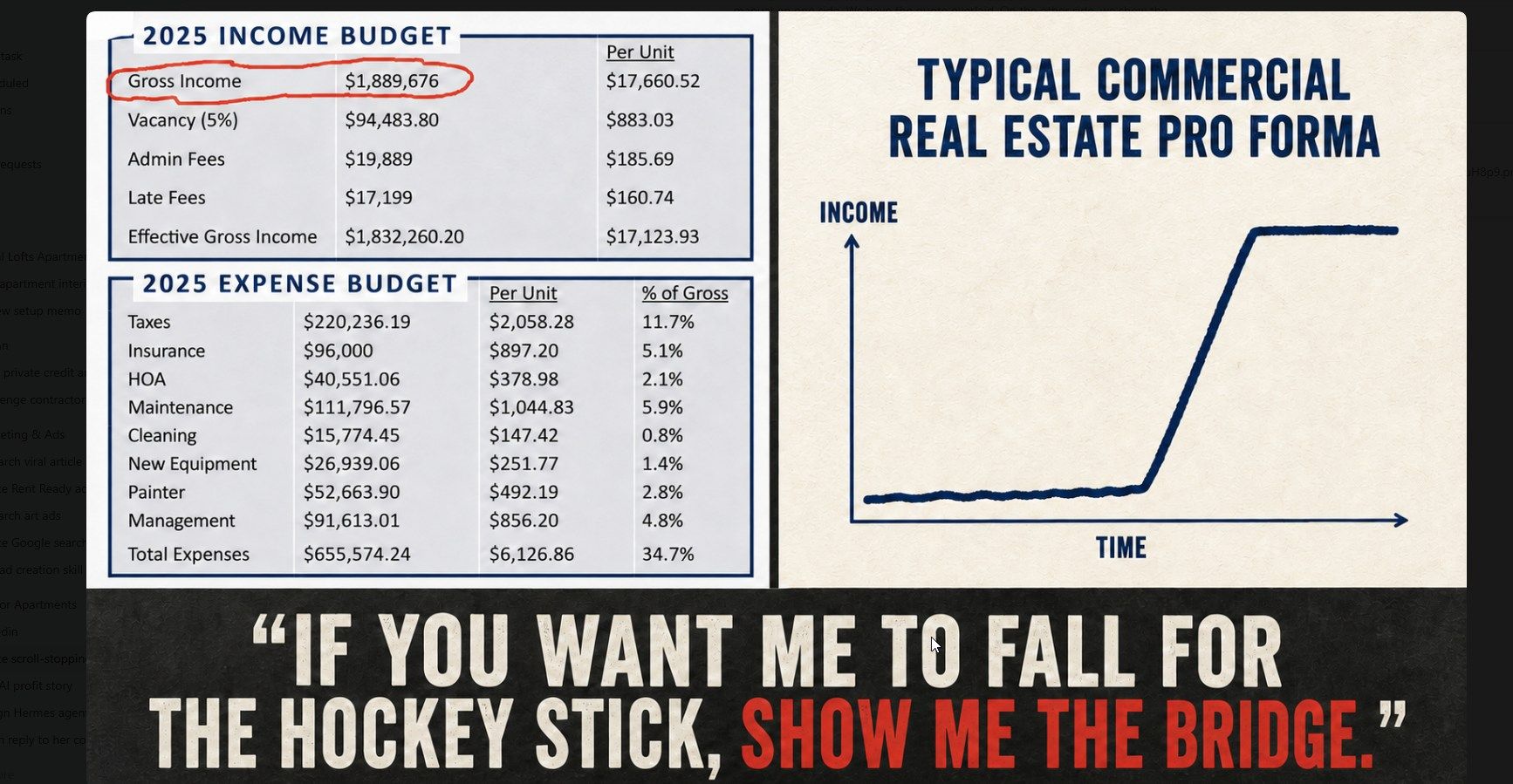
How to Catch a Pro Forma Lying
Asked my underwriter what a concession was.
"Discount from market rent to lease rent."
I smiled. "You sure?"
"Yeah. What else could it be?"
"Isn't that also the definition of loss-to-lease?"
He scratched his head.
A lot of the underwriting packages I see, including $50M ones, treat these as the same number. They aren't.
Loss-to-lease is the gap between the market rent you're claiming and what tenants actually pay under signed leases. It lives on the rent roll.
Concessions are the discounts you granted on top of that. Upfront (one month free, prorated across the year). Recurring (a piece off every month). Then the ones that get coded separately: employee, courtesy officer, utility credits, dispute settlements.
You cannot look at one without the other. Different columns. Both hit collections. Same effective rent tells you a different story depending on which one drove the gap. Loss-to-lease says raise on renewal. Concessions say the market is soft.
Why is this so important when looking at pro formas?
A deal crossed my desk. Property was collecting $120K a month. The broker's pro forma showed $142K on day one after close.
What's the mechanism? No one could answer. Properties don't add $22K in collections the day the deed transfers. Not unless a burn-off is scheduled or a rent spike is contractual, and neither was.
The new, higher rents were input into the model.
The number was a wish that got annualized.
Maybe they could get to these numbers in time. But you have to work through the leasing bell curve first.
This is why I build a month-by-month budget on every deal I underwrite. Every line, bridged from what the property is today to what I'm claiming it becomes.
Yearly pro formas hide the miracle month. Monthly ones expose it.