Writing · AI / Automation / Tech
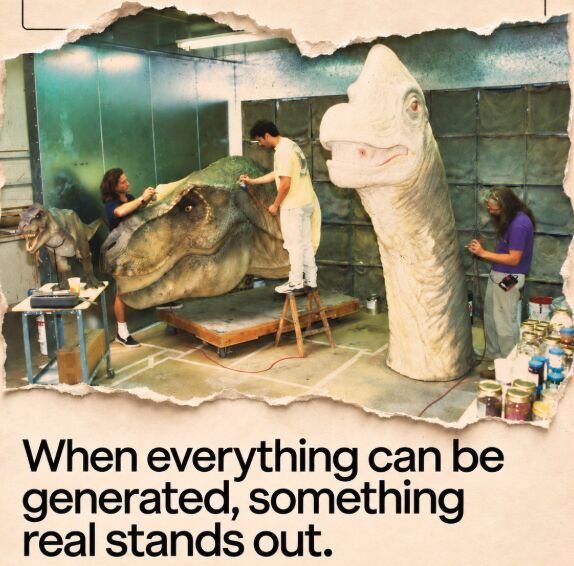
In 1991, Steven Spielberg hired Phil Tippett to make the dinosaurs for Jurassic Park. Tippett was a stop-motion guy who moved puppets one frame at a time. He had already won an Oscar for his creature work on Return of the Jedi, so the dinosaurs were supposed to be his.
Then a team at Industrial Light & Magic made test footage of dinosaurs on a computer, and Spielberg went with the computer.
Tippett goes, "I've just become extinct!"
Spielberg borrowed the line and put it in the movie.
He also kept Tippett. Tippett understood how an animal moves and behaves, so he ended up supervising the animators on 50 dinosaur shots, his own studio's people and ILM's. He won a second Oscar for it. The Walt Disney Family Museum says stop-motion as a movie effect was all but wiped out after that. Not everybody in his trade got kept.
He kept his own film going anyway. In 1990 he'd started a stop-motion film called Mad God. He shelved it, picked it back up in 2010, raised $124,156 on Kickstarter against a $40,000 goal, and finally premiered it in 2021. Thirty-one years.
I thought about him when I read the Wall Street Journal on November 2. A stop-motion studio in Oregon says it went from saying yes to almost every ad brief to turning work down. Apartment D Films in Burbank, whose co-founder directed e.l.f.'s new holiday spot, estimates its inquiries doubled in two years. A Gallup and Bentley poll has 39% of Americans saying AI does more harm than good, up from 31% last year.
The art world has paid for effort forever. So it's refreshing to see a backlash against AI slop.
Funny thing, though. The best detail in the piece is a fake: an Instagram Reel of a hand-built miniature Miami getting flattened by a wave in a 40-foot tank, captioned "No CGI," with nearly 700 million views. It was made entirely with AI. I'd bet most of those views came from people who thought somebody built it.
So effort is now worth faking too. 🤪
I build with AI every day, and my advice for your ads and marketing is to use less AI, not more. Buyers are tired, and I think the backlash gets a lot bigger from here.
Marketing was a sea of sameness long before AI showed up. Now the tide is rising.
Anyone can make a copy of anything they can imagine, as fast as they can type it. When every brand is pouring more water in, the ad that stands out is the one where you can tell a person did the thinking. Value goes to whatever is scarce. When images cost almost nothing, the scarce thing is a human really thinking through what should be in that image.