Writing · Capital / Finance / Investing
In 2006, we CRE investors were geniuses. Then 2008 showed up. Buyers walked away from six-figure earnest money, and some sued over a one-inch floor plan discrepancy just to get out.
I thought about that last week reading Jason Kirsch in Forbes. His headline: "Tight Credit Spreads Are Hiding The Next Refinancing Problem." He's writing about corporate borrowers. Citing FTI Consulting, he says BB and B leveraged loan spreads ended 2025 near this century's lows. Then he says, "Tight spreads aren't a lie." They describe the biggest, healthiest borrowers, and the weak ones hide inside the average.
Fair enough. But I remember what tight looked like the last time, and Trepp wrote the history.
In the frothiest days before the crash, Trepp says, benchmark CMBS bonds sold at about 25 basis points over swaps. A quarter of a point! That was the market calling commercial real estate loans about as safe as anything gets.
One of those loans was $225 million on the Riverton, a 1,230-unit rent-stabilized complex in Harlem bought for $131 million in 2005. The loan was sized on the rents they planned to get as units turned over, so on paper the coverage was 1.73. On the rents actually coming in it was 0.39. That's 39 cents of income per dollar of debt service, with a reserve to cover the gap. The reserve ran out in summer 2008. The loss was nearly $107 million.
By late 2008, the senior AAA bond in a benchmark 2007 deal was quoted at 1,500 basis points over Treasuries!
Trepp says it in one sentence: "While credit quality was falling dramatically before the crisis, so were lending spreads."
A spread tells you how the people with the money feel that week. Whether the loan is any good is in the documents: the leverage, the coverage, and the covenants.
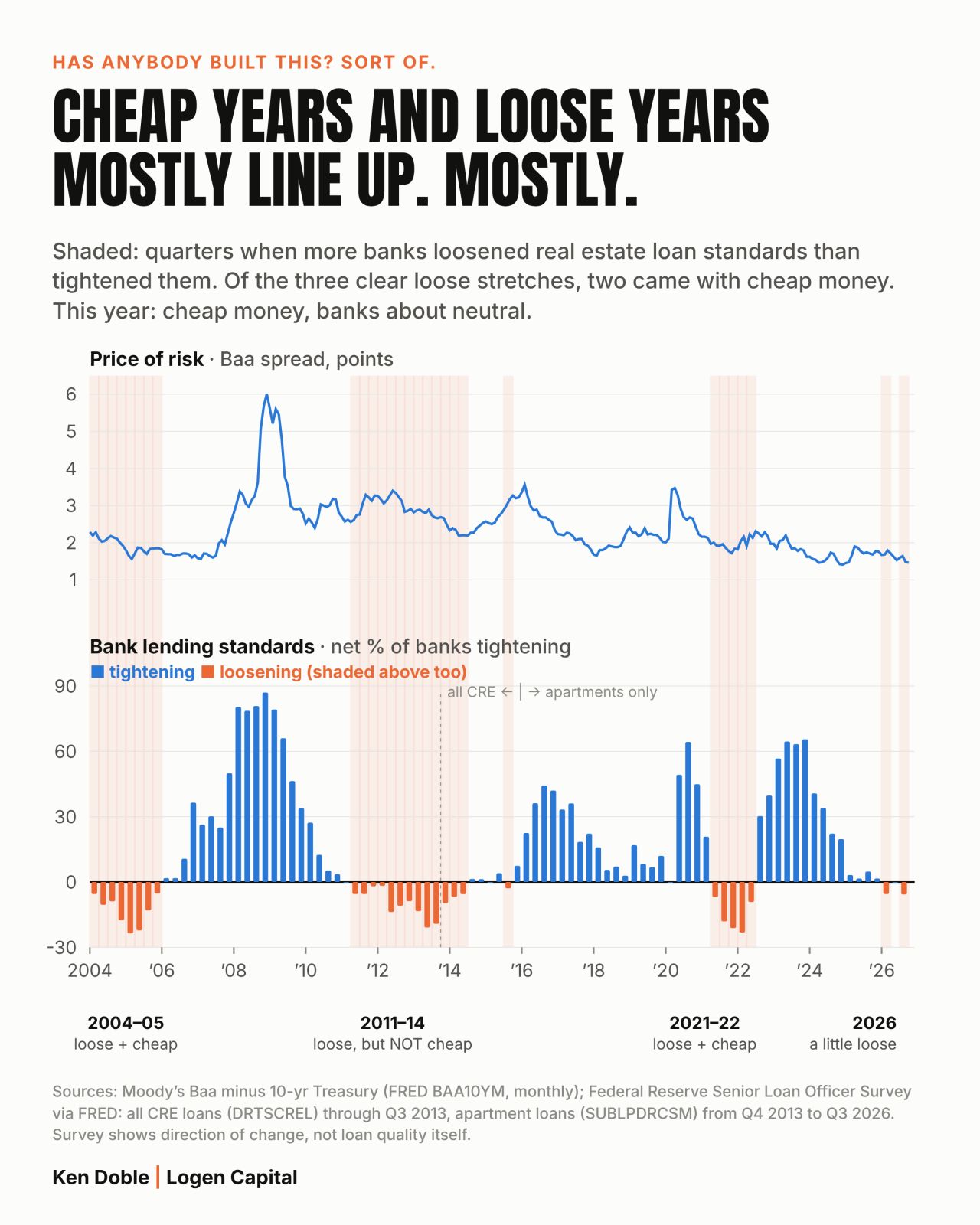
Bond buyers feel pretty good right now. Moody's Baa corporate bonds were 1.48 points over the 10-year Treasury on November 12. 2007's low was 1.53. The high, in December 2008, was 6.16.
The closest public data I found is the Fed's loan officer survey. Since 2004, banks clearly loosened real estate standards three times. Two of those came with cheap money. The exception, 2011-14, came right after the crash.
I'm not predicting anything, and I've got no business doing it. In 2012 I was sure rates had to go up, so we locked in fixed debt, then we paid millions in defeasance when we sold early. On the one deal we took floating-rate debt, rates spiked, debt service went up $1.5 million in a year, and cash flow went from 12% to 3%. I've been wrong in both directions. At least I'm diversified. 🤪
What I'd like to see is apartment loan spreads laid next to LTV, DSCR, and covenants, year by year, back through 2008. Has anybody built that? I want to know whether the loans made in the cheap, sloppy years keep blowing up on CRE investors a few years later.