Writing · Pricing / Revenue Management
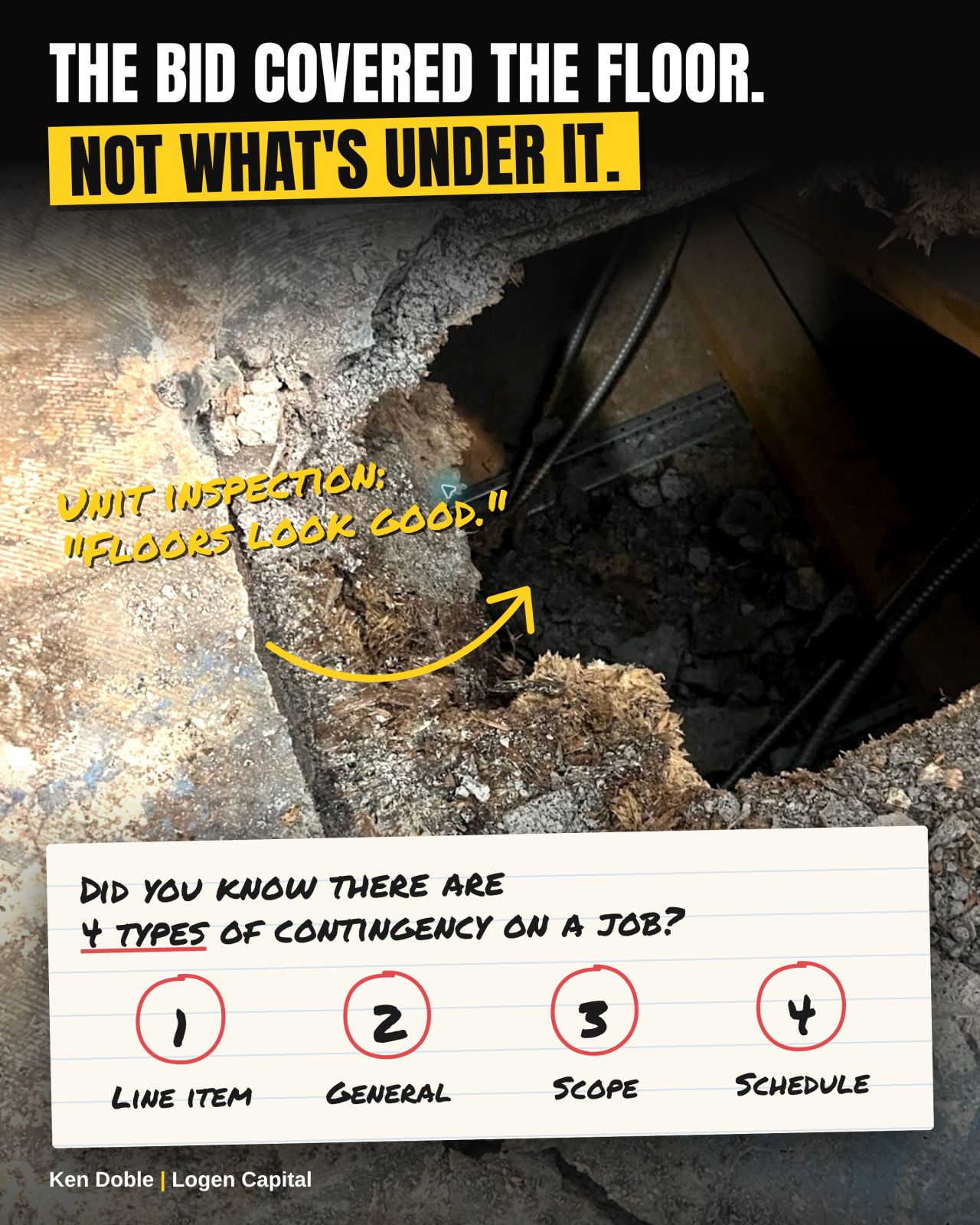
Overbudget. Over time. Over it.
Three weeks into demo, the crew cuts through the Gypcrete. Underneath, the subfloor is mush. Water had been sitting there for who knows how long, turning wood into oatmeal.
Wait, isn't your unit-by-unit inspection supposed to catch this? Sure. If you walk every square inch of every floor in every unit.
Now you have two phone calls to pick from. Call your investors and ask for more money. Or open the contingency you built for exactly this day.
One of those calls is a lot more fun.
I've done hundreds of renovations and new builds. The fastest way I know to wreck a deal is to shrink the contingency so the numbers work. It looks smart in Excel.
Second mistake, on almost every budget I review: one line that says "contingency." You need four.
1. Line item contingency
Pad the items where surprises live. Pool deck bid says $50K? Carry $60K. You know, you know, there are cracked pipes under there.
2. General contingency
The catch-all. My subfloor came out of this bucket. How big it should be depends on how much you actually know.
Where are your drawings? Schematics, or 15, 20, 30% or more into construction drawings? How tight are your bids? Solid bid coverage, or one number from one guy? Have you done this exact work before?
Done 100 rehabs just like this one, recently, same market, same contractors? You don't need 15 or 20%. Brand-new market, or a piece of rehab you've never touched? Go higher.
And know whose contingency it is. Yours and your GC's are two different buckets. Negotiate shared savings on the GC's. Funny how fast a GC protects your money once some of it is theirs.
3. Scope contingency
The lever you pull when the first two run dry. You picked imported stone for the pool. Then the roof comes in over. Swap to a good basic tile. Same work, smaller check, and the pool still looks great.
4. Schedule contingency
Your GC says 6 months. It takes 12. Supervision, rentals, overhead and interest eat your pro forma alive.
Delays stack. Push plumbing and you push drywall, and when drywall slides the inspection slides, and miss that inspection and now you're missing leasing season. In student housing, miss August and you wait a year.
And the longer it drags, the more prices move. The quote on bid day isn't the price on buy-out day, especially with tariffs bouncing around. Carry an escalation line.
My rule: always round up. Assume it goes sideways. If you don't need the cash, send it back.
Will padding cost you a deal now and then? Sure. Somebody with a skinny contingency will outbid you. Let them have it. I'd rather lose a deal on paper than in reality.
Nobody has ever called me upset about a check they weren't expecting.
Ask for more money midstream and watch what happens. Confidence vanishes. Blame starts flying.
What's the line item that always blows up on your jobs?