Writing · Pricing / Revenue Management
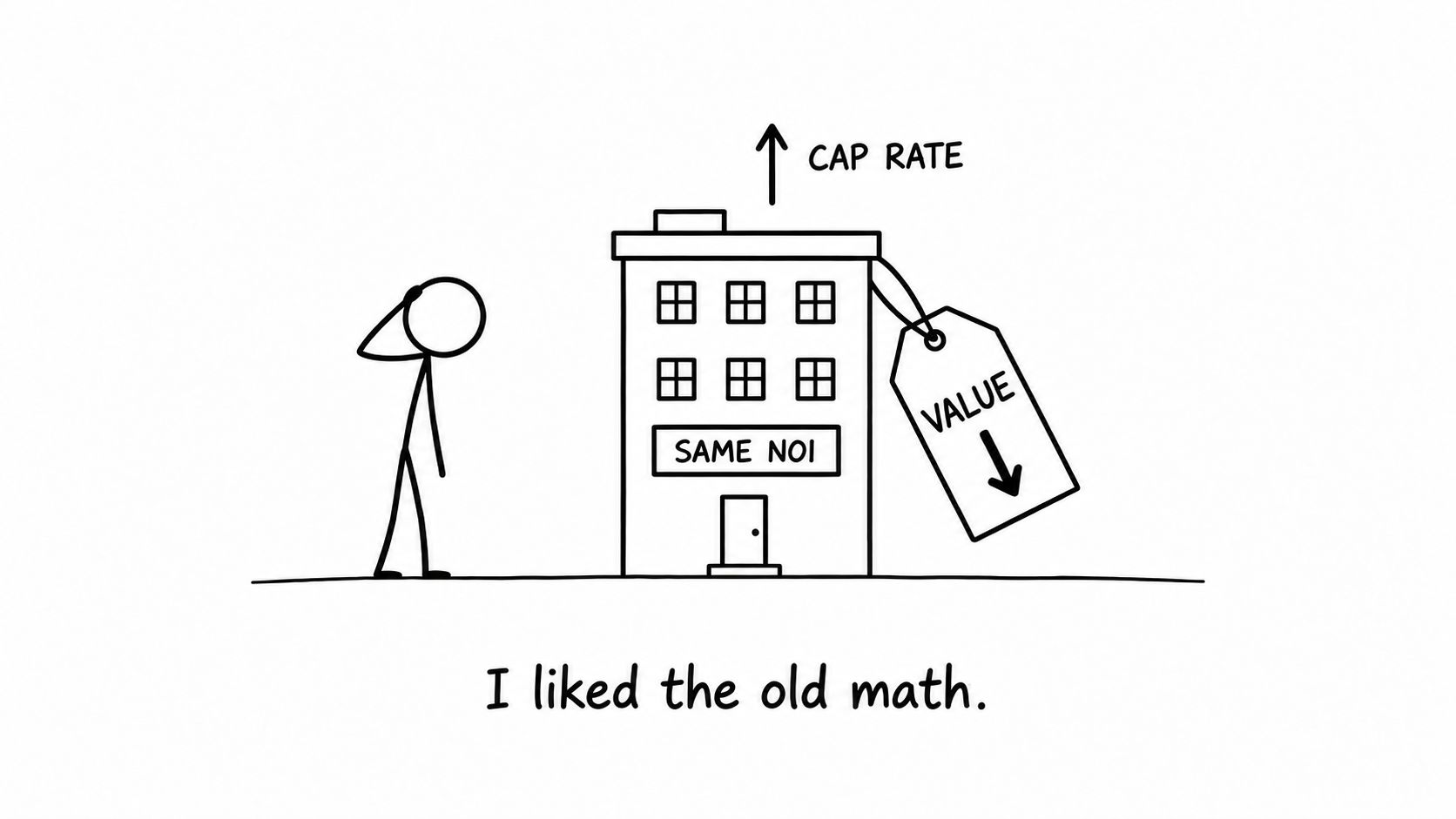
𝗧𝗵𝗲 𝟭𝟬-𝗬𝗲𝗮𝗿 𝗠𝗼𝘃𝗲𝗱 𝗔𝗯𝗼𝘂𝘁 𝟭𝟬𝟬. 𝗖𝗮𝗽 𝗥𝗮𝘁𝗲𝘀 𝗗𝗶𝗱𝗻'𝘁.
The Fed hiked 25 basis points on September 16, its first since July 2023. The 10-year, which prices agency debt, moved more: under 4% in late February, 5% this week.
Say you're buying 200 apartments with $2.0 million of NOI at a 5.25% cap, or $38.1 million. The agency lender sizes to 1.25x coverage on 30-year amortization, with three years of interest-only. At 6.10%, that's a $22.0 million loan, 58% of the price, and 4.1% cash-on-cash in year one.
Add 25 basis points. The loan drops $574,000. At the same price, your equity check grows by that much and year-one cash-on-cash slips to 3.8%. That 2.6% cut holds for any loan sized to coverage on 30-year amortization near 6%. An LTV-capped loan may not move.
Second-order effects
Run the full 100 and the loan shrinks $2.2 million, to 52% of the same price. The rate deleveraged the deal. To hold a 4.1% year-one return, the buyer can pay $34.3 million, a 5.83% cap and about 10% less.
At 3.8%, the deal yields less than a Treasury that pays 5% and never calls about a clogged toilet. The LP's question becomes how fast the plan grows NOI.
Cap rates haven't followed. Garden apartments backing 2026 CMBS loans carry a 5.51% cap, per CRED iQ, about 50 basis points over the 10-year. CBRE's 2010-2020 multifamily spread averaged 230. Agency spreads, roughly 15 basis points tighter since January per Berkadia, softened the blow.
Ares puts the long-run correlation between cap rates and the 10-year near 0.1. From 2004 to 2006 the Fed raised rates 400 basis points while apartment cap rates fell 90, per CohnReznick. Still, CBRE's work since 1995, which also weighs rents and inflation, finds apartment cap rates move about 75 basis points per 100 on the 10-year.
Third-order effects
MIT's Bokhari and Geltner found loss aversion played a major role in commercial deal pricing from 2001 to 2009, strongest at the 2007 peak and at least as strong among experienced institutions. Sellers anchored to their basis cut slowly. Buyers who can't hit their returns walk. We lived that in 2009 trying to buy: volume dried up to almost nothing, and JLL put Americas deal volume 85% below the 2007 peak. If a broad repricing comes, expect the freeze first.
We're already seeing distressed deals trade far below their 2021 and 2022 prices, and Green Street has apartment values 19% below the 2022 peak. A foreclosure doesn't price like a stabilized building, so those trades won't map neatly onto a healthy asset.
If higher rates shelve marginal starts, fewer units deliver in two or three years, and less supply supports the rents owners are counting on.
Buffett compared rates' pull on asset prices to gravity on an apple. If CBRE's average catches up with this year's 100, this building goes to a 6.00% cap. An owner at 70% debt loses 42% of the equity on paper. At 87.5% debt, all of it.