Writing · AI / Automation / Tech
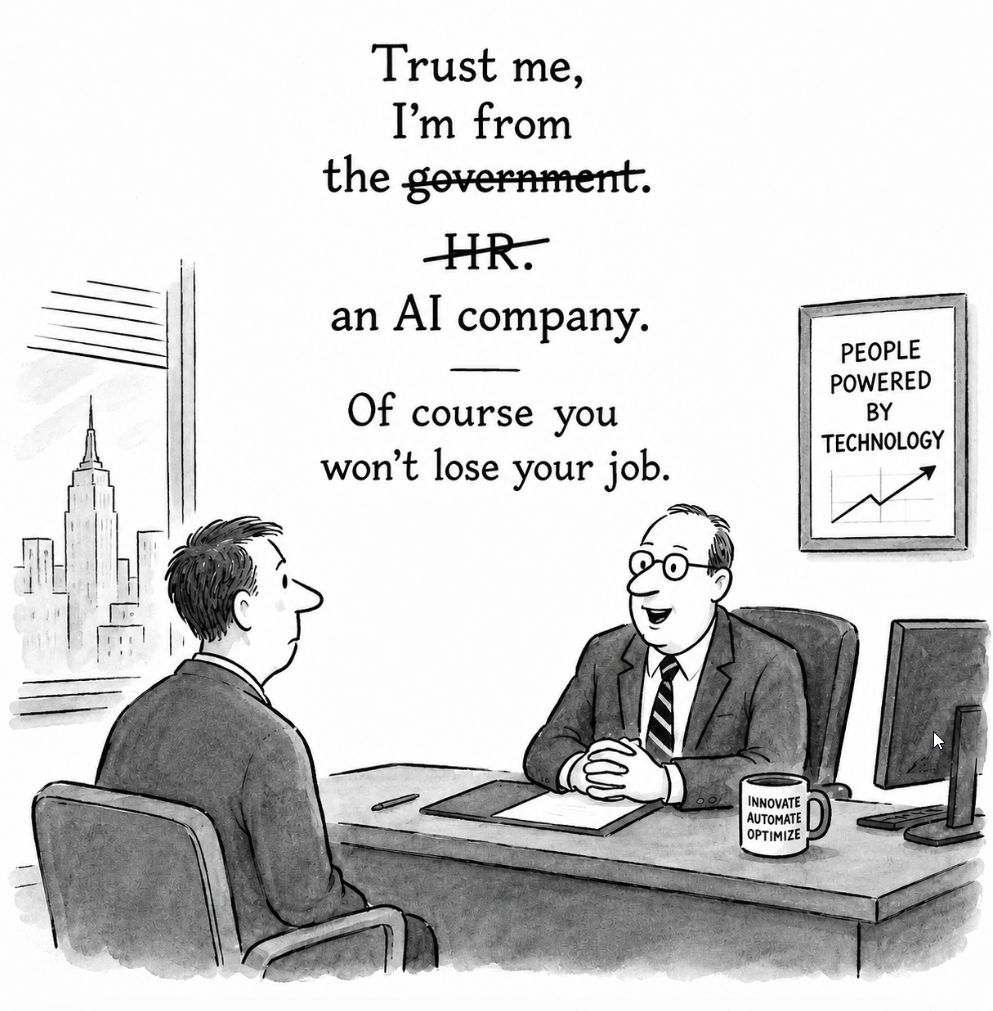
This isn't about cutting heads,' says the manual that explains how to cut heads.
A $2.2 billion proptech firm just published a 262-page manual for apartment landlords. Most of those pages have nothing to do with the software. They coach you on what to tell your staff while you install it.
More than 30 communication templates, all circling one message: don't worry, the AI isn't here for your job.
The same manual explains how to cut payroll 10 to 20%.
Your employees are not dumb.
Start with what AI can't do, no robots assumed.
It can't walk a unit and sign off on the move-out inspection. It can't be the body at a site that won't allow self-guided tours. It can't stand across from a resident having the worst day of their lease. And when the software gets it wrong, a human is the one who has to own it.
The physical site is the floor. Everything above it is coordination and admin, and that is what Elise eats first. Leasing inquiries, scheduling, applications, rent reminders. It starts at the front desk and works inward.
So the org chart doesn't shrink evenly. It hollows out in the middle. The body on site holds. Senior judgment and taste holds too, just with fewer people each covering more. The busy middle goes first.
Which makes retraining the real story, the one the manual buries. Retrain them to do what, exactly? Run the AI instead of the inbox. Handle the exceptions it kicks up, and own the calls it can't.
Your leasing agent stops being chained to one desk and floats to the sites that still need a human face. One property manager starts running several. One senior accountant rides on top of digital employees and covers 50 deals instead of 8.
The assistant manager is the role with nowhere to climb. It lived in the middle, and over time it mostly disappears.
Fewer people, harder work. Less busywork, more judgment. The seats that survive are worth more per head, so pay per person can climb even as headcount drops. Just don't sell it as more jobs. It's fewer jobs that pay better and ask more.
You need 30 templates to sell a lie. You need a training plan and one straight answer to sell the truth: fewer seats, better work, move early.
A $2.2 billion company is concerned about its image and has built exactly the manual it needs to sell it. The one thing they couldn't automate was a straight answer. So they shipped thirty templates instead.