Writing · Pricing / Revenue Management
Your Memo Has Holes. Capital Reads Holes as Risk.
A big multifamily portfolio crossed my desk recently. Many buildings, a lot of units, a serious raise. I passed. I never even got to the price. The package had holes, and capital reads holes as risk.
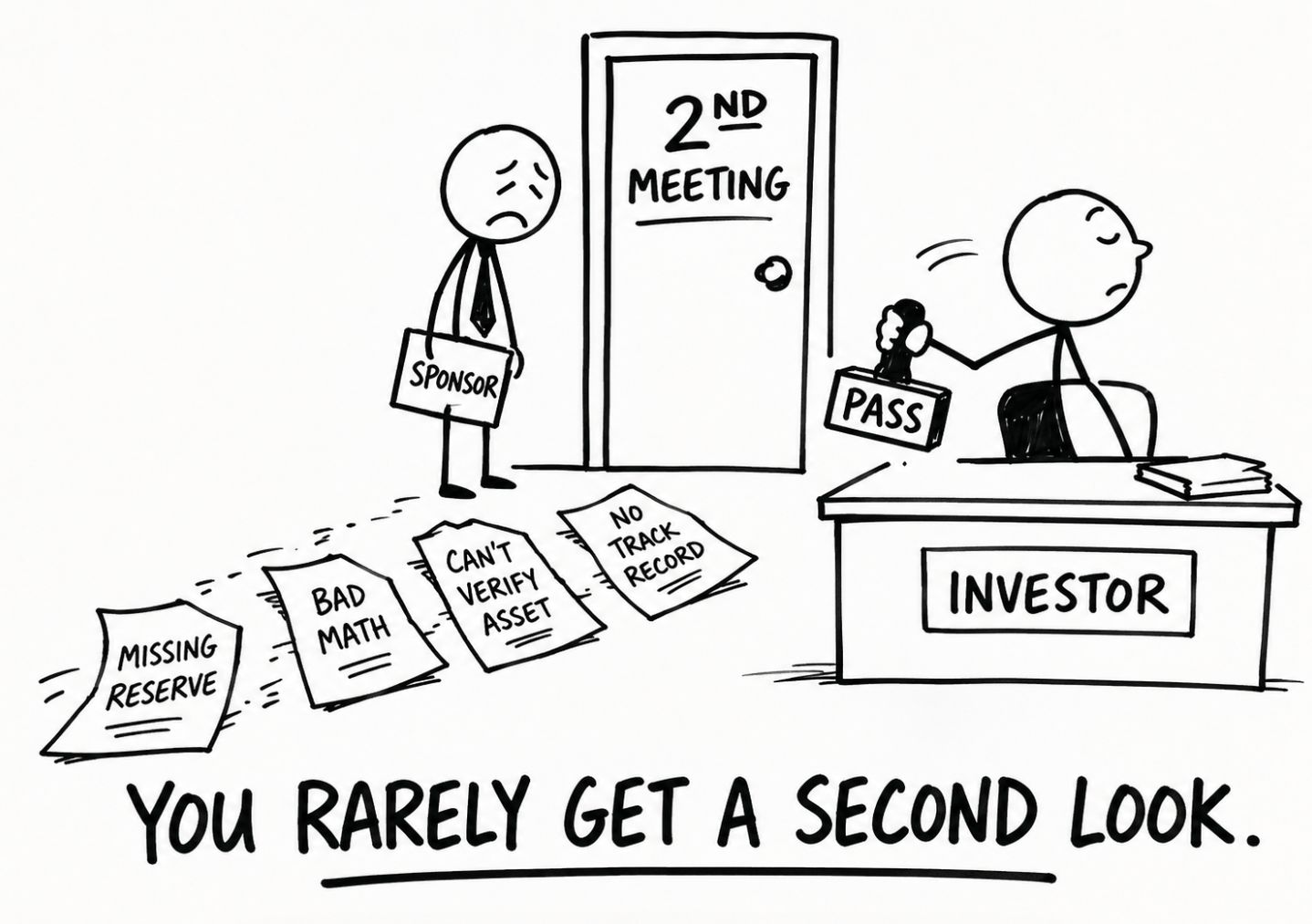
Every gap I hit spent a little trust, and by the time I had counted the missing reserve, the numbers that didn't add up, and four buildings I couldn't even find in the data, I'd spent it all before I reached the part that mattered. Read a first look as a trust test. The underwriting comes later, if you earn the meeting. Every number that ties earns you credibility. Every gap spends it.
Run out before you close, and there's no second meeting. So I ran their memo through my model and wrote down what a complete package needs.
Works for any raise, one building or fifty.
Numbers that tie. The parts have to add up to the headline. If your properties sum to one number and your "basis" shows a bigger one, explain the gap before I ask. An unexplained gap tells me you didn't check, or you hoped I wouldn't.
The whole cost stack. Closing. Points. A rate cap. Working capital. Leave them out, and the deal looks cheaper than it is. That missing line makes me wonder what else got skipped.
A reserve for the gap. Buy something that needs work, and the income won't cover the loan while you fix it. Show me the reserve that carries the shortfall. "It's in the rehab budget" is a fine answer, if you can point to the line.
Real skin in the game. On a big raise, the sponsor holds five to ten percent of the equity. Their cash. Money parked in another deal is not money in this one. If you're not in it, why am I?
A track record. A big check for a first-timer is a hard sell. Turning a stack of beat-up buildings at once is a specialized skill. Done it before? Lead with it. Haven't? Tell me who on your team has.
Assets I can verify. If I can't find the property in the data, I can't underwrite it. "Trust me" is not a comp.
A plan to execute. Who does the work? Who runs it after? A plan with no names on isn't a great one. None of this is exotic. Any sponsor should know it cold.
But I've watched good sponsors lose good deals on a sloppy first draft, and I've handed over a rough one myself and watched the whole room go quiet.
You learn.
Have the relationships? You get some slack. New? You don't. Every gap is trust you can't spare. Capital says no to confusion faster than it says no to a bad deal.
Everything here is just my opinion. I could be wrong, I could be right. It is intended solely for entertainment and to provoke thought, not as legal, financial, or investment advice. You can't rely on it and frankly, should probably not rely on some post by a complete stranger. Or maybe you should - who knows? Do your own diligence before you act on any of it. Or don't. It all rests with you.